

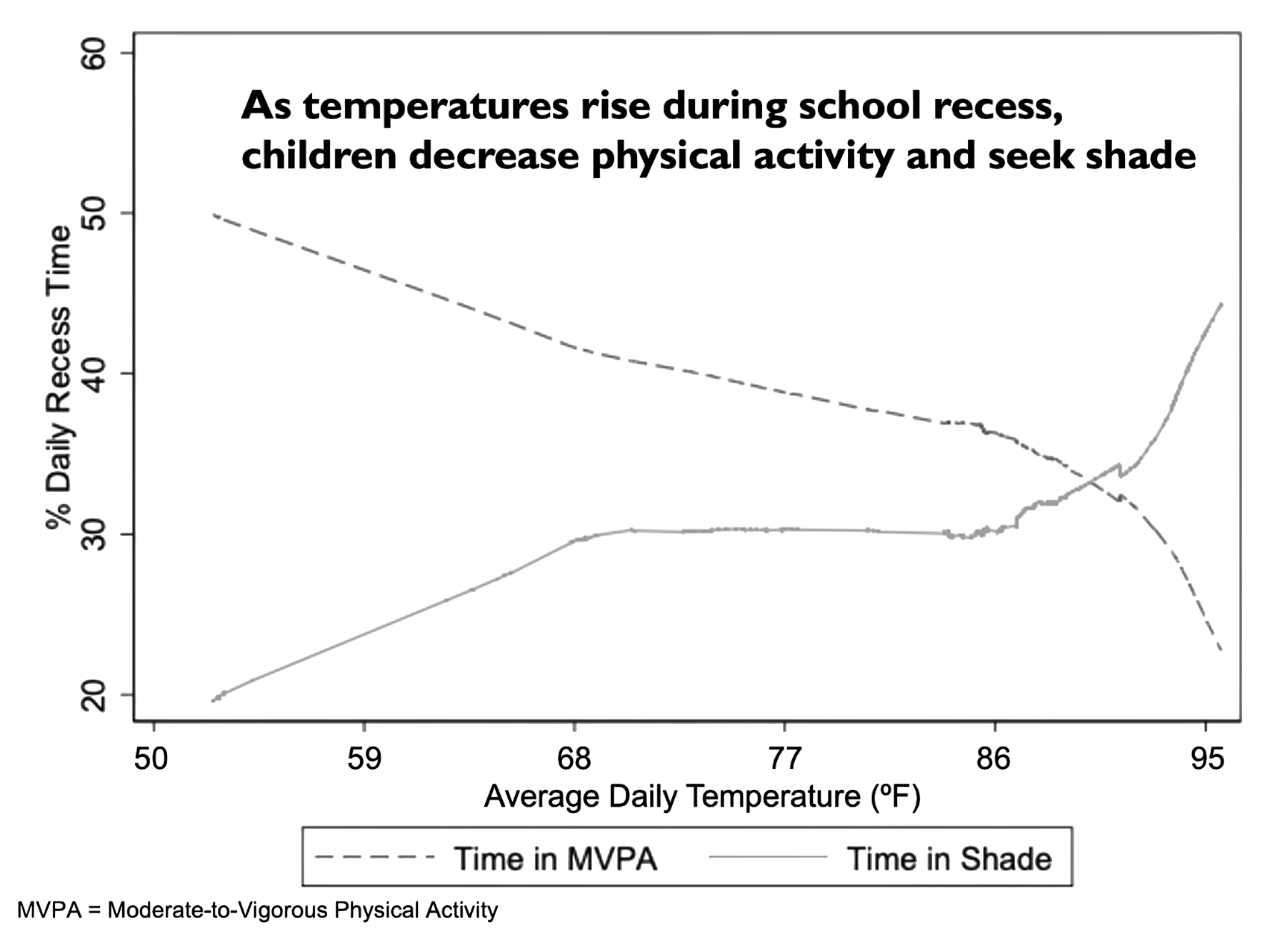
Only about one-quarter of US children are meeting federal recommendations for physical activity, missing out on the many benefits of being active including improved brain health, cardiovascular health, and long-term health. Extreme heat—the likes of which are projected to increase with climate change and urban development patterns—can be a barrier to children engaging in physical activity due to thermal discomfort. High temperatures can also be dangerous by increasing children’s risk of exertional heat illness. The HEAT Lab investigates the temperature-physical activity relationship where children live, learn, and play. This includes examining heat stress and active commuting to and from school, connecting behavior with infrastructure design. We design and test potential solutions for decreasing heat stress and promoting physical activity in support of child health in our warming world.
Select Projects
Green Schoolyards Project: Here’s a one-pager (in English and Spanish language) that summarizes the project, its findings, and recommendations based on project findings.
Select Publications
Zhang, Y., Burford, K. G., Pérez, A., Lanza, K., Salvo, D., Baker, B. A., & Hoelscher, D. M. (2025). Poor agreement between teacher perceived and objective measures of weather conditions for school-based physical activity research. Preventive Medicine Reports, 103328. https://doi.org/10.1016/j.pmedr.2025.103328
Szeszulski, J., Faro, J. M., Joseph, R. P., Lanza, K., Lévesque, L., Monroe, C. M., … & Lee, R. E. (2023). How societal forces of change are transforming youth physical activity promotion in North America. Journal of Physical Activity and Health, 20(12), 1069-1077. https://doi.org/10.1123/jpah.2023-0167
Lanza, K., Jones, J., Acuña, F., Coudert, M., Bixler, R. P., Kamath, H., & Niyogi, D. (2023). Heat vulnerability of Latino and Black residents in a low-income community and their recommended adaptation strategies: A qualitative study. Urban Climate, 51, 101656. https://doi.org/10.1016/j.uclim.2023.101656
Koepp, A. E., Lanza, K., Byrd-Williams, C., Bryan, A. E., & Gershoff, E. T. (2023). Ambient temperature increases and preschoolers’ outdoor physical activity. JAMA pediatrics, 177(5), 539-540. https://doi.org/10.1001/jamapediatrics.2023.0067
Lanza, K., Alcazar, M., Durand, C. P., Salvo, D., Villa, U., & Kohl, H. W. (2022). Heat-resilient schoolyards: relations between temperature, shade, and physical activity of children during recess. Journal of Physical Activity and Health, 20(2), 134-141. https://doi.org/10.1123/jpah.2022-0405
Poulos, A., Wilson, K., Lanza, K., & Vanos, J. (2022). A direct observation tool to measure interactions between shade, nature, and children’s physical activity: SOPLAY-SN. International Journal of Behavioral Nutrition and Physical Activity, 19(1), 127. https://doi.org/10.1186/s12966-022-01355-4
Lanza, K., Gohlke, J., Wang, S., Sheffield, P. E., & Wilhelmi, O. (2022). Climate change and physical activity: ambient temperature and urban trail use in Texas. International journal of biometeorology, 66(8), 1575-1588. https://doi.org/10.1007/s00484-022-02302-5
Lanza, K., Alcazar, M., Hoelscher, D. M., & Kohl III, H. W. (2021). Effects of trees, gardens, and nature trails on heat index and child health: design and methods of the Green Schoolyards Project. BMC public health, 21(1), 98. https://doi.org/10.1186/s12889-020-10128-2
Research Areas
- Heat-Safe Youth Physical Activity Promotion
- Active Transportation Environments
- Climate Change, Health, and Adaptation in Africa
- Nature-Based Volunteering and Youth Health