

Walking, cycling, and taking the bus or train are healthier travel modes for people and the planet compared to personal vehicle use, yet oftentimes there are factors that limit participation and safety. The HEAT Lab investigates the barriers and facilitators of active transportation for existing users and non-users. We explore environmental exposures (e.g., heat stress, air pollution, noise pollution, nature elements), built environment characteristics, and social factors that may influence active transportation use and both its perceived and actual safety. Together with community members, municipalities, and transit authorities, we build evidence for policies that support healthier and safer active travel for everyone.
Select Publications
Lanza, K., Allison, B., Chen, B., Wilson, P. S., Hunt, E. T., Burford, K. G., … & Keitt, T. H. (2025). Ambient environmental exposures while cycling on a vegetated trail versus the road. Urban Climate, 61, 102429. https://doi.org/10.1016/j.uclim.2025.102429
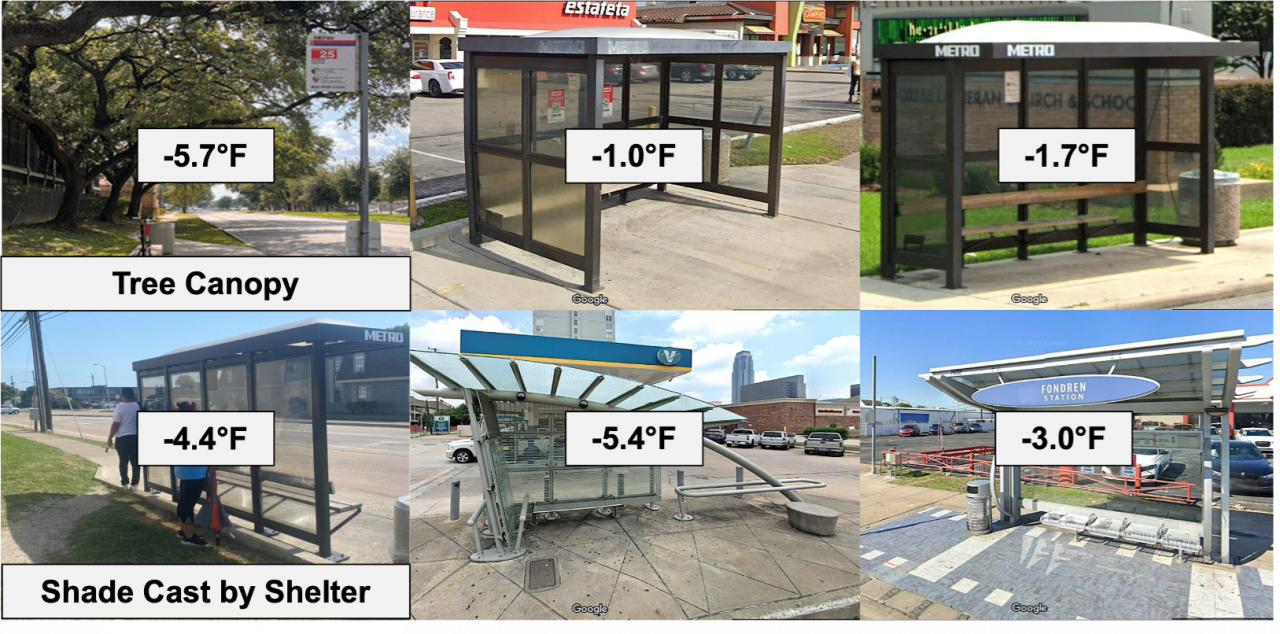
Lanza, K., Ernst, S., Watkins, K., & Chen, B. (2025). Heat stress mitigation by trees and shelters at bus stops. Transportation Research Part D: Transport and Environment, 140, 104653. https://doi.org/10.1016/j.trd.2025.104653
Lanza, K., Jones, J., Acuña, F., Coudert, M., Bixler, R. P., Kamath, H., & Niyogi, D. (2023). Heat vulnerability of Latino and Black residents in a low-income community and their recommended adaptation strategies: A qualitative study. Urban Climate, 51, 101656. https://doi.org/10.1016/j.uclim.2023.101656
Lanza, K., Gohlke, J., Wang, S., Sheffield, P. E., & Wilhelmi, O. (2022). Climate change and physical activity: ambient temperature and urban trail use in Texas. International journal of biometeorology, 66(8), 1575-1588. https://doi.org/10.1007/s00484-022-02302-5
Lanza, K., Burford, K., & Ganzar, L. A. (2022). Who travels where: Behavior of pedestrians and micromobility users on transportation infrastructure. Journal of transport geography, 98, 103269. https://doi.org/10.1016/j.jtrangeo.2021.103269
Lanza, K., & Durand, C. P. (2021). Heat-moderating effects of bus stop shelters and tree shade on public transport ridership. International journal of environmental research and public health, 18(2), 463. https://doi.org/10.3390/ijerph18020463
Lanza, K., Oluyomi, A., Durand, C., Gabriel, K. P., Knell, G., Hoelscher, D. M., … & Kohl III, H. W. (2020). Transit environments for physical activity: Relationship between micro-scale built environment features surrounding light rail stations and ridership in Houston, Texas. Journal of transport & health, 19, 100924. https://doi.org/10.1016/j.jth.2020.100924
Research Areas
- Heat-Safe Youth Physical Activity Promotion
- Climate-Responsive Active Transportation
- Climate Change, Health, and Adaptation in Africa
- Volunteering and Youth Health