

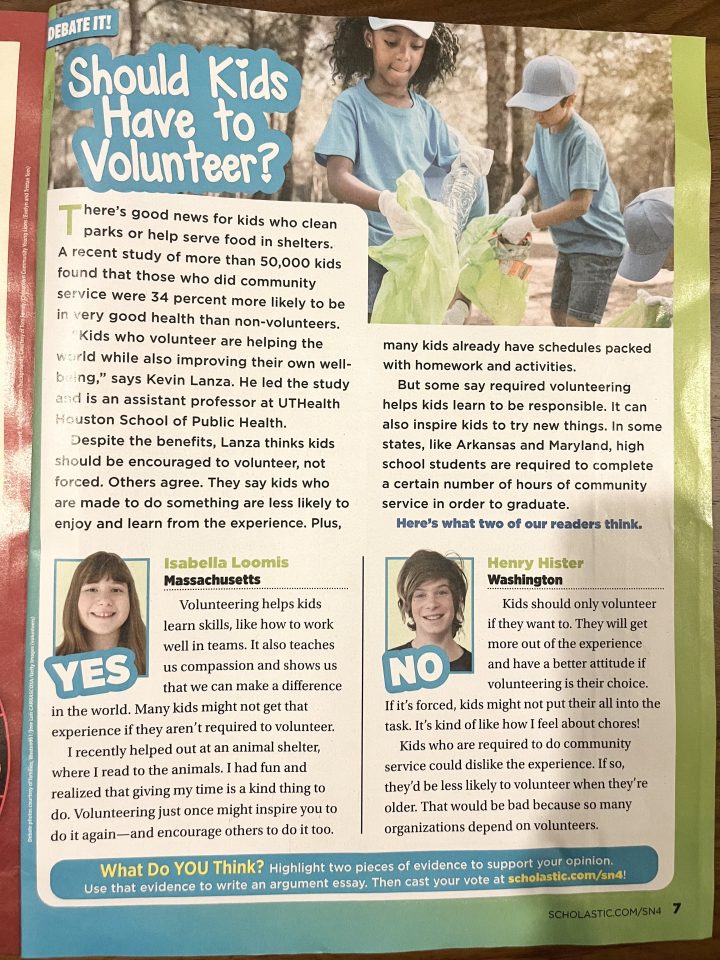
Participation in volunteering or community service—doing unpaid work to help others and/or the environment—has been linked to improved health and well-being of older adults, yet little information exists on whether volunteering benefits youth. Further, volunteering may be a strategy to combat the US epidemic of loneliness and isolation, which has increased the risk of depression and anxiety among children and adolescents that remains high even years later. The HEAT Lab investigates the relationship between participation in volunteering by youth and their 24-hour movement behaviors, physical health, mental health, and social health. This work informs the development of volunteering as a potential health intervention wherein youth help others and help themselves.
Select Publications
Lanza, K., Lies, M., Gutierrez-Kapheim, M., Krogen, M., & Benjamins, M. R. (2025). Adolescent volunteering in the United States: associations with friendship and behavior outcomes. Children and Youth Services Review, 108612. https://doi.org/10.1016/j.childyouth.2025.108612
Pfledderer, C. D., Brown, D. M., Lanza, K., Hunt, E. T., Porter, C. D., Parker, H., … & Brazendale, K. (2025). Out-of-school Activities and Adherence to 24-hour Movement Guidelines. American Journal of Preventive Medicine, 68(1), 66-74. https://doi.org/10.1016/j.amepre.2024.08.016
Lanza, K., Hunt, E. T., Mantey, D. S., Omega-Njemnobi, O., Cristol, B., & Kelder, S. H. (2023). Volunteering, health, and well-being of children and adolescents in the United States. JAMA Network Open, 6(5), e2315980-e2315980. https://doi.org/10.1001/jamanetworkopen.2023.15980
Lanza, K., Alcazar, M., Chen, B., & Kohl III, H. W. (2023). Connection to nature is associated with social-emotional learning of children. Current Research in Ecological and Social Psychology, 4, 100083. https://doi.org/10.1016/j.cresp.2022.100083